Overview
The clock_time subsystem provides a unified, high-resolution time base and programmable event scheduling for RT-Thread. It decouples a monotonic counter (clock source) from deadline delivery (clock event), so platforms can mix hardware counters and timers while the kernel and libc see consistent behavior.
Architecture
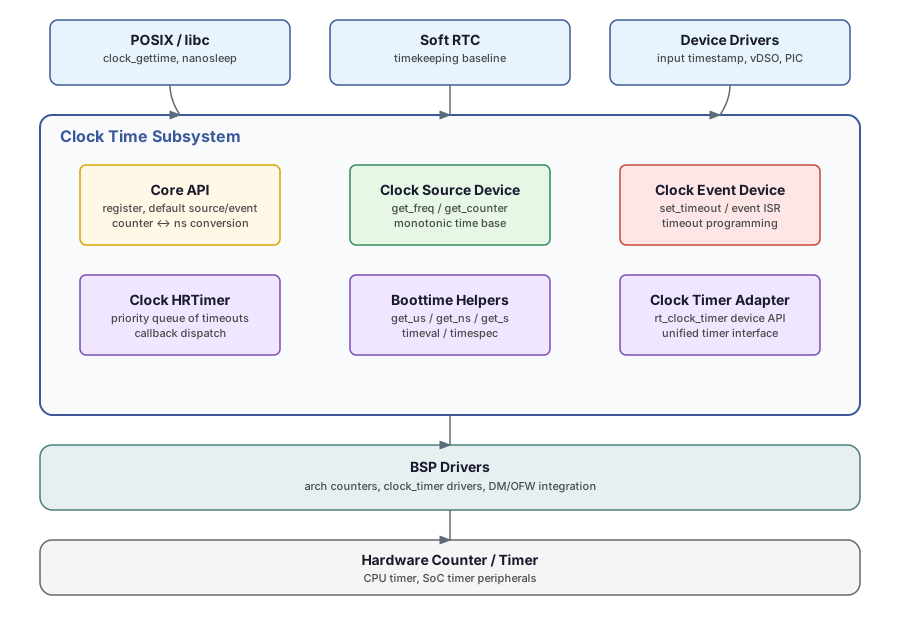
Layering and Responsibilities
- Upper layers:
- POSIX/libc time APIs (clock_gettime, nanosleep) use boottime and hrtimer APIs.
- Soft RTC uses boottime as its monotonic time base for timekeeping.
- Device drivers (input event timestamps, vDSO, PIC statistics) use boottime for timestamping.
- clock_time subsystem: core APIs, clock source/event devices, the hrtimer scheduler, boottime helpers, and the clock_timer adapter.
- Lower layers: BSP drivers provide hardware counters and timers, which are wrapped as clock_time devices or clock_timer devices.
Internal Components
- Core API (clock_time_core.c)
- Registers clock_time devices, manages default source/event selection, and provides counter <-> nanosecond conversion with fixed-point scaling.
- Clock source device (rt_clock_time_device + RT_CLOCK_TIME_CAP_SOURCE)
- Supplies a free-running counter and frequency for monotonic time reads.
- Clock event device (rt_clock_time_device + RT_CLOCK_TIME_CAP_EVENT)
- Programs the next deadline and calls rt_clock_time_event_isr() on expiry.
- Clock hrtimer (clock_hrtimer.c)
- Schedules high-resolution timeouts, programs the next event, and dispatches callbacks. Falls back to software timer when no hardware event is available.
- Boottime helpers (clock_boottime.c)
- Converts the monotonic counter into timeval/timespec/seconds for upper layers.
- Clock timer adapter (clock_timer.c)
- Exposes a unified hardware timer device (rt_clock_timer) and can register itself as a clock_time event device.
- Architecture sources (arch/* and clock_time_arm_arch.c)
- Provide fast CPU counters or architectural timers and register them as the default clock source when available.
Data Flow
- Read path
- Clock source counter -> scaled resolution -> nanoseconds -> boottime or clock_gettime.
- Timeout path
- HRTimer queue -> next expiry -> set_timeout on event device -> event ISR -> hrtimer processing -> callbacks.
Configuration
Enable the subsystem in menuconfig:
RT-Thread Components ->
Device Drivers ->
[*] Clock time subsystem (RT_USING_CLOCK_TIME)
Optional settings:
- CLOCK_TIMER_FREQ (RISC-V): base counter frequency used by the clock source.
- RT_CLOCK_TIME_ARM_ARCH: enable ARM architected timer integration (DM/OFW).
BSP Integration Checklist
- Provide a clock source:
- Register a rt_clock_time_device with CAP_SOURCE, or use the provided architecture source (AArch64/RISC-V) via rt_clock_time_source_init().
- Provide a clock event:
- Register a rt_clock_time_device with CAP_EVENT and call rt_clock_time_event_isr() in its interrupt handler.
- Or register a rt_clock_timer device; it can become the default event device automatically.
- Keep event ISRs short; heavy work should run in thread context if needed.
Detailed Documents

 1.9.1
1.9.1